Category: Culture Tips

  • Party Grammar!

    Party Grammar!

    Learn some collocations, prepositions, colloquial language and common expressions you can use for socialising.  Your English friends will be impressed and amazed!

    Collocations

    Verb + party

    To have a party

    To throw a party

    To organise a party

    ‘I’m having a party!  Can you come?’

    ‘We’re throwing a party for my sister’

    ‘Can you help me organise the office party?’

    Party invitation – if you are invited to a formal party, you will receive a formal invitation that you must reply to.  The invitations may have RSVP on it – this means ‘répondez s’il-vous-plait’ which is French for ‘please respond’.  There will be details – usually an email address or a website where you can confirm your attendance.

    Party + noun

    A ‘party girl’ is a girl who loves going to parties, clubs, pubs – she likes having fun.

    Party clothes – clothes you wear to a party

    Party pooper – somebody who doesn’t like parties.  A party pooper is somebody who often refuses an invitation to a party. ‘what a party pooper!’

    Prepositions:

    To

    ‘I’ve been invited to a party!’ 

     ‘I went to a wonderful party last night’

    At

    ‘Were you at Jim’s party last week’

    ‘I was at this crazy party last week’

    ‘I’m at the party – why don’t you come?’

    Use for when you’re organising a party

    ‘I’m having a party for my birthday’

    Expressions:

    ‘The party’s in full swing’ – very busy and noisy

    ‘The party broke-up around midnight’ – the party ended around midnight

    ‘the party went on all night!’

    When you leave – thank you hosts:

    ‘Thank you so much for inviting me – I’ve had a wonderful evening’

    Colloquial Expressions:

    ‘Let’s party!’ – this means ‘let’s have some fun’

    ‘Party on!’ (phrasal verb) this is colloquial and can be a way of saying goodbye when you’re leaving a party encouraging your friends to stay and have fun. You would say ‘party on guys’ as you left.

    ‘Keep partying!’ 

    Phrasal Verbs:

    Dress-up – wear your most glamorous clothes!

    Types of party

    Drinks party – just drinks (Champagne, Prosecco or wine) and nibbles.  A drinks party is usually from 7pm till 9.30pm.

    Cocktail party – the same as a drinks party, but you drink cocktails.

    Tea party – tea, sandwiches, cakes and biscuits.  A tea party starts at about 4.30pm and finishes around 6pm.

    Lunch party – lunchtime in the UK is around 1pm.  A formal lunch party is similar to a dinner party but at lunchtime.  Dress up!

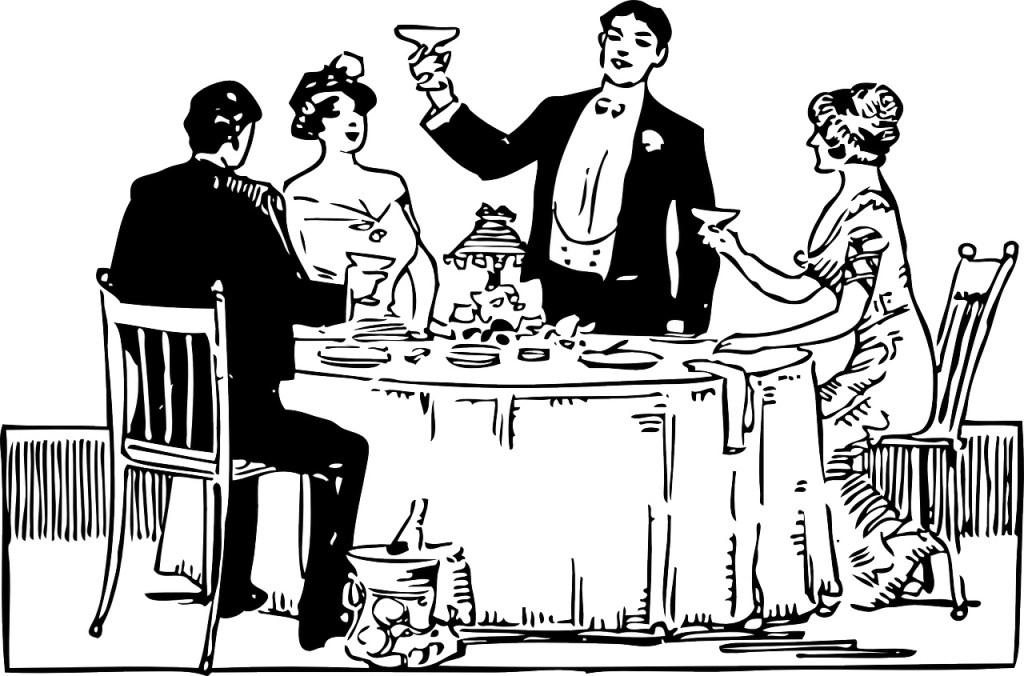
    Dinner party – dress up for a dinner party and arrive around 7.30pm till 11ish.

    Supper party – no need to dress up.  A supper party can be a casual affair – maybe in your friend’s kitchen.  Usually for a few close friends, from 7pm till 10ish.  

  • 3 Types of Party

    3 Types of Party

    Brits love to party!  If you have recently moved to the UK or are thinking of visiting you may be invited to a party.  Here are 3 types of party, what to expect and some helpful expressions to use.

    Informal Dinner Party

    A dinner party is a great opportunity to get to know people.  There will typically be 6 to 8 guests, and you should wear something glamorous, (women) and for men – look sharp. You will be doing lots of flirting!

    Sharp (colloquial): something new, fresh and clean that makes you feel cool and look hot.

    Glamorous: attractive in an exciting way

    Hot: sexy

    Who will be there:

    Host or hostess – the people giving the party.  If they are cooking then it’s nice to ask if there’s anything you can do to help:

    ‘May I help?’

    They will thank you but say no and offer you a drink.

    Other guests: your host or hostess will aim to balance male and female guests so in a party of 6, there will probably be 3 men and 3 women.

    If your host is busy cooking and doesn’t introduce you to the other guests, then you should introduce yourself:

    ‘Hello, I’m (your name) – it’s lovely to meet you’

    Must Do’s

    Take a bottle of wine.

    Compliment the chef and if you would like to have a second helping, you say:

    ‘This is sooo delicious – may I have some more?’

    Second helping: more food.

    When it’s time to leave, thank your host and hostess:

    ‘Thank you so much for inviting me!  I’ve had a wonderful evening.’

    Formal Black Tie Dinner Party

    Your host and hostess will be very rich, and this will take place in a large house (London) or country pile (in the countryside).  At a formal black tie dinner party, the seating plan is important.  There is a social hierarchy that must be observed, or you risk upsetting somebody.  The married lady of the most important guest sits to the right of the host and the most important male guest sits to the right of the hostess.  

    When dinner starts, you must talk to the person on your right.  After the first course you talk to the person on your left.  After you have spent some time talking to the person on your left, you are free to join in any conversation within earshot.

    Country pile: A colloquial expression that means a very large house in the countryside.

    Seating plan: the hostess will have decided in advance where everyone will sit around the table, which will be large, and she will have taken great care to work out who will be sat next to who.

    Social hierarchy: social system which ranks people according to their status.  For example, in the UK, a man with a title (Lord, Earl, Sir) will be ranked higher than one without.  See my blog on British titles.

    Observed: in this sense, observed means obeyed.

    Risk: the possibility of something bad happening

    Within earshot: that you can hear, i.e. within your range of hearing.

    Range: an area, within limits. In this case, the limits are set by how good your hearing is.

    Dress code (what to wear)

    Women: dress up.  Lots of jewellery.

    Men: Black tie.  This means a black suit, white shirt, bow tie and cuff links.  Make sure your shoes are black and polished.

    Who will be there

    Formal black tie dinner parties are for the rich.  If your fellow guests are members of the British upper class, be warned that they can be cliquey and you may feel nervous.  Don’t!  This is an affectation and once they’ve had a glass or two of wine, they will become much more fun.  

    Cliquey: difficult to get to know.  Cliquey people are not immediately friendly to people who are not in their social circle.

    Social circle:  group of friends – usually of similar class or financial status.

    The Office Party

    If you work in the UK, you will probably be invited to an office party sometime in December and possibly a second one in the Summer.  It is traditional to drink too much at office parties.  Everybody has a wonderful time and it’s a great opportunity to ‘let your hair down’ and relax with your colleagues.

    Let your hair down’ (idiom: relax and enjoy yourself without worrying about formalities

  • My Story!

    My Story!

    I was born in Wales.  I had an extraordinary childhood as my father inherited an old and crumbling castle by the sea which is where I grew up with my brother and sister.  My parents loved to entertain.  My father was one of her Majesty’s Lord Lieutenants which is a royal appointment.  It meant that he was required to look after any visiting royalty or members of parliament and so home wasn’t just a fairytale setting—it was also a stage for countless grand occasions. 

    Growing up, I attended many formal parties.  My father was required to host visiting royalty and we had several Prime Ministers to stay, including Sir Edward Heath and the disgraced head of the liberal party, Jeremy Thorpe at the height of the murder scandal 😱!  He arrived in a helicopter, and we had to move all the cows out of the field in front of the house and paint a large white circle on the grass for the helicopter pilot. 

    I grew up in an extraordinary world, full of invisible rules and traditions experienced first-hand from a young age and can safely call myself an expert on the culture of British social life from top to bottom.  I would like to guide you through it in a light-hearted manner as well as providing you with useful language for socialising in the UK.

    Crumbling: in a bad state – falling down

    Inherit: something precious that is given to you by somebody close to you after they are dead. They write a will, and ask the lawyer to make sure that you receive a gift of money / jewellery / property that belonged to them.

    A will: a legal document written by people who have something of value they want given to somebody after they’ve died.

    In a light-hearted manner: Don’t take me too seriously!

    To take something/someone seriously: to believe that everything they say is true.